My preconception of Harrods is obvious. Snooty rich people, wandering around, with bags upon bags of shopping. Shop assistants looking down their nose at people they don’t think can afford anything. Doormen with top hats.
I was pleasantly surprised when my most recent trip to Harrods ended in a very full stomach, a new choice of perfume and a smile on my face.
Entering the perfumery, thousands of different smells whirled around, overpowering my senses. “You get used to it, imagine being in here everyday, it makes your sense of smell so much better”, one sales assistant explains how she deals with it whilst offering coffee beans.
After feeling like I’ve smelt a million perfumes, I go back to my old favourite, old reliable Dior. Then, the double ‘C’ catches my eye, and the sweet smell of Coco Mademoiselle drifts around me.
Can I ditch Christian for Coco? Maybe it’s time for a change.
Friday, 12 December 2008

Don't get your hopes up

Nearly two years ago, after making an impromptu trip to the Tate Modern, I got my first tattoo inspired by a sculpture, by Marcel Duchamp, I saw on my visit. So, the Tate Modern already has a place deep in my heart.
Walking up South Bank on a blustery Wednesday afternoon, complete with scarf-on-head to protect from the rain, the anticipation of seeing the sculpture again, that influenced my life, hit me. With the warehouse-like building looking almost oppressing, I felt something wasn’t right.
Making my way hastily through the other exhibition’s, dragging a very uninterested male friend behind me; I came across the case where Marcel Duchamp’s “Rose Sélavy” sculpture used to be. Used-to-be.
Rekindling my love for fashion...
Recently, my spare time has been filled with begrudgingly looking at pictures of catwalk shows on Style.com.
Prancing into Harvey Nichols on a chilly Wednesday morning suddenly made my entire catwalk gawking and stalking feel worth while. The bright, clean perfumery and make-up floor gave the department store a slightly clinical feel. But, how was I to know that, up the escalator I would find something that would make my heart beat faster than seeing Jude Law in the Epsom Grill.
I was starting to think that I was falling out of love with fashion, which saddened me. Until I saw a pair of leggings. Bizarre, I know, but these leggings made me feel nothing I had ever felt before. After staring at the Autumn/Winter 2008 Alexander McQueen show pictures in awe, I never thought that in front of me would be something he created. A pair of black leggings totally covered in sequins, amazing.
After this close encounter with a genius and embarrassing myself after seeing an amazing pair of Christian Louboutin shoes, it was time to go. It was time to go before the after-fashion glow wore off.
Prancing into Harvey Nichols on a chilly Wednesday morning suddenly made my entire catwalk gawking and stalking feel worth while. The bright, clean perfumery and make-up floor gave the department store a slightly clinical feel. But, how was I to know that, up the escalator I would find something that would make my heart beat faster than seeing Jude Law in the Epsom Grill.
I was starting to think that I was falling out of love with fashion, which saddened me. Until I saw a pair of leggings. Bizarre, I know, but these leggings made me feel nothing I had ever felt before. After staring at the Autumn/Winter 2008 Alexander McQueen show pictures in awe, I never thought that in front of me would be something he created. A pair of black leggings totally covered in sequins, amazing.
After this close encounter with a genius and embarrassing myself after seeing an amazing pair of Christian Louboutin shoes, it was time to go. It was time to go before the after-fashion glow wore off.
A Place like home
Possibly my new favourite shop in the whole of London, A Child of the Jago opened my eyes into the fascinating world of menswear, antiques and strangely enough, warthogs. I rushed into the shop, 15 minutes before closing, the shop assistant, complete with 80’s style George Clooney moustache, reassured me that it was fine for me to wander around and chill out for as long as I wanted.
I glanced at Joe Corre as he wandered up the stairs, “Hey, you alright?” he smiled. I stood there thinking: Oh my god, your mother is Vivienne Westwood and you helped design some of the underwear worn by the sexist women in the world like Dita Von Teese. I tried to be nonchalant, whilst stumbling on the stairs.
Downstairs, I was greeted by a very large, stuffed warthog, staring at me with its beady eyes; it watched me as I wandered around the room. The antiques and obscure objects that were kept in the basement of A Child of the Jago left me confused and bedazzled. A leg of a Hell’s Angel. A blood-stained vest worn by a knight. Cabinets full of antique razors and combs. The shop and its contents are most definitely a place of wonder.
I glanced at Joe Corre as he wandered up the stairs, “Hey, you alright?” he smiled. I stood there thinking: Oh my god, your mother is Vivienne Westwood and you helped design some of the underwear worn by the sexist women in the world like Dita Von Teese. I tried to be nonchalant, whilst stumbling on the stairs.
Downstairs, I was greeted by a very large, stuffed warthog, staring at me with its beady eyes; it watched me as I wandered around the room. The antiques and obscure objects that were kept in the basement of A Child of the Jago left me confused and bedazzled. A leg of a Hell’s Angel. A blood-stained vest worn by a knight. Cabinets full of antique razors and combs. The shop and its contents are most definitely a place of wonder.
All American Man
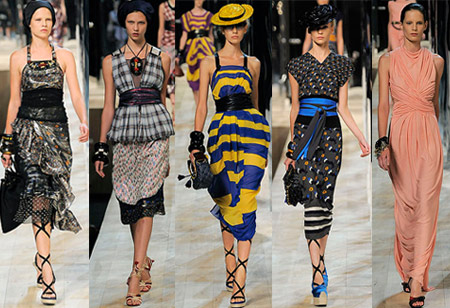
It was a trip to the House on the Prairie with Marc Jacobs collection for Spring/Summer 2009 shown in New York.
He used layered vintage foil fabrics, flattened boater hats and hobble skirts to create the Americana Country Girl theme which ran throughout his collections.
“Rhapsody in Blue” blared out from the speakers echoing patriotism whilst Jacobs models shimmied down the catwalk split with Stefan Beckman’s staggered mirrored pillars.
The key looks were gingham shirts, much like those seen in Jacobs’ 1992 collection for Perry Ellis, tucked into hobble skirts and cinched at the waist with cummerbunds. The mismatch and layering of various metallic foil fabrics gives the collection a vintage tone enhanced by the eclectic brooches, necklaces and tribal bangles. Jacobs also layered; simple shirts with buttoned collars and jersey jumpers finished off with Capri trousers to complete the prairie girl look.
With hair scraped back into a tight plait or turbans covering the hair, Marc Jacobs made it apparent this season that it is all about the clothes and the workmanship. He embroiders flowers and shapes onto the already intricate fabrics, the clever drapery and tailoring gave a powerful hourglass figure for a sophisticated but modern woman.
As the collection comes to a close it is apparent that canary yellow was prominent on Marc Jacobs’s mood board. The colour is scattered through his pieces, often contrasting it with bold colours like electric blue. He uses a wide range of colours, the deep reds and midnight blues used at the beginning of the collection and the prominent bright blues and yellows coming through towards the end of the show.
The key pieces of the show included: a flowing chiffon dress, cinched at the waist, features both canary yellow and electric blue in thick stripes, conjuring up images of a circus big-top. Tabard and apron style dresses were also prominent maintaining the all American prairie girl theme. The accessories were proven to be a major part of the show with most models carrying quilted shoulder bags, clutch bags or feed bags in a mismatch of colours and prints, often animal. The choice of shoe for Jacobs Spring/Summer 09 collection was a variant on the Espadrille which was tied up the leg. Simple sandals with a soft cone stiletto heel and ankle strap were also often teamed with the Capri trousers and power suits.
Jacobs collection although commercial is very wearable, each garment can be worn separately or styled in a different way, the New York designer just offers one option, the possibilities are endless.
He modestly states after the show, “I’m not interested in my opinion, I’m interested in what you think and what you see”, well Marc, you’ve done it again. With countless celebrities and industry professionals, Victoria Beckham, Elijah Wood and Cathy Horyn of the New York Times, to name a few, expressed their love for the collection, it is obvious that Marc Jacobs Spring/Summer show is seen as one of the best and most influential of the year.
Tuesday, 4 November 2008
Slightly off topic - Whats the Big Deal about Organ Donation?
One person in the United Kingdom dies every day due to not receiving an organ transplant in time. This is a plea. Not only for your hearts, but for your kidneys, livers, corneas and anything else you are willing to donate.
There are over 7,500 patients within the United Kingdom that are waiting for organ transplant. However, the scheme currently working in the UK means that if a person dies, their organs cannot be used, unless they are signed up to the Organ Donation Register.
In a recent survey, of 2000 people by the BMA’s Medical Ethics Committee, just over a quarter were registered organ donators. Yet, nearly two thirds of people questioned agreed that they would be willing to donate their organs after their death.
The “Opt-Out” scheme, which is currently under review, has come under fire by some individuals claiming that they do not wish for, “the state to own their body” or due to religious beliefs. The scheme is, initially, exactly what it says on the tin. People wishing for their organs not to be used after their death can “Opt-Out” by simply signing a piece of paper. Those who do not “Opt-Out” are ultimately giving presumed consent for the use of their organs after their death. It’s simple.
The “Opt-Out” transplant system has been introduced in many European countries, including Spain where the transplant rate is three times higher than in the UK. Their “soft” presumed consent system is encouraged by the UK Government as it takes into account the wishes of the relatives before an organ donation is made. However, in Austria a “hard” presumed consent is enforced and relatives are not consulted before organ donation of the deceased.
With the number of people needing a transplant rising by 8% each year, it is essential that the government enforces the presumed consent system, if not compulsory donation after ones death.
Those objecting to the presumed consent system due to their lack of trust in the NHS and medical systems should understand that; if those thousands waiting for an organ transplant received what they are entitled to, a life, the NHS would save £150million a year. If saving a life is not a good enough reason to donate organs, then saving millions of pounds a year, which could be used on improving the NHS, must be an adequate motive.
Ed Balls, the Schools Secretary, is now insisting that every secondary school pupil is educated and encouraged into donating their organs after their death. A free, “Give and Let Live” pack has been sent to secondary schools across the country, aimed at 14 to 16year olds, to inform them of the affects of blood, organ and tissue donation and how they can get involved. In my opinion, all students should also be educated on living donations where pieces of your liver, lungs or kidneys can be used to save a life.
The subject of organ donation can turn into one of those conversations at the pub, “Would you give me your kidney, if I needed it?” Of course, whether the entire truth was told is another story, everyone would automatically agree because when it’s personal it’s a lot easier to relate. To me, organ donation is seen as an act of altruism, however in this day and age, I feel it should be compulsory and seen as normality.
There are over 7,500 patients within the United Kingdom that are waiting for organ transplant. However, the scheme currently working in the UK means that if a person dies, their organs cannot be used, unless they are signed up to the Organ Donation Register.
In a recent survey, of 2000 people by the BMA’s Medical Ethics Committee, just over a quarter were registered organ donators. Yet, nearly two thirds of people questioned agreed that they would be willing to donate their organs after their death.
The “Opt-Out” scheme, which is currently under review, has come under fire by some individuals claiming that they do not wish for, “the state to own their body” or due to religious beliefs. The scheme is, initially, exactly what it says on the tin. People wishing for their organs not to be used after their death can “Opt-Out” by simply signing a piece of paper. Those who do not “Opt-Out” are ultimately giving presumed consent for the use of their organs after their death. It’s simple.
The “Opt-Out” transplant system has been introduced in many European countries, including Spain where the transplant rate is three times higher than in the UK. Their “soft” presumed consent system is encouraged by the UK Government as it takes into account the wishes of the relatives before an organ donation is made. However, in Austria a “hard” presumed consent is enforced and relatives are not consulted before organ donation of the deceased.
With the number of people needing a transplant rising by 8% each year, it is essential that the government enforces the presumed consent system, if not compulsory donation after ones death.
Those objecting to the presumed consent system due to their lack of trust in the NHS and medical systems should understand that; if those thousands waiting for an organ transplant received what they are entitled to, a life, the NHS would save £150million a year. If saving a life is not a good enough reason to donate organs, then saving millions of pounds a year, which could be used on improving the NHS, must be an adequate motive.
Ed Balls, the Schools Secretary, is now insisting that every secondary school pupil is educated and encouraged into donating their organs after their death. A free, “Give and Let Live” pack has been sent to secondary schools across the country, aimed at 14 to 16year olds, to inform them of the affects of blood, organ and tissue donation and how they can get involved. In my opinion, all students should also be educated on living donations where pieces of your liver, lungs or kidneys can be used to save a life.
The subject of organ donation can turn into one of those conversations at the pub, “Would you give me your kidney, if I needed it?” Of course, whether the entire truth was told is another story, everyone would automatically agree because when it’s personal it’s a lot easier to relate. To me, organ donation is seen as an act of altruism, however in this day and age, I feel it should be compulsory and seen as normality.
Get Your Leg Over - Your Guide to the Latest Trends
Leggings should be a staple in your wardrobe this Autumn/Winter with lace, wet-look and the “Soft Goth” look prominent on the catwalks, leggings are the easiest translation of these trends. Think tight, shiny and lacy, Alexander McQueen created a pair completely covered in sequins, not a bit like those eighties numbers featured in Fame!
With black being the unmistakable favourite colour of many designers this season, it’s obvious that; Black is the new black. Yves Saint Laurent, Givenchy and the King of Gothic; Alexander McQueen all uncovered their sinister sides, using different textures, materials and shades. Even though wearing all black and dramatic make-up may seem a bit daunting, we’re offering a new way for you to embrace this season’s dark trend without looking like Mortisha Adams.
Sometimes creating a wearable on trend outfit may seem like an impossible task. Don’t worry about piling on every item of black, lacy, wet-look clothing you own; invest in a few good pairs of black leggings varied in texture and it’ll definitely vamp up your wardrobe.
Designers and the high street are whipping up various versions of leggings for you to squeeze into. Les Chiffoniers has cleverly mastered some amazing wet-look black PVC leggings which would look super-vamp and very stylish under a long t-shirt or with a plain black top. If you’re purse strings don’t stretch that far, (£200 might be a bit steep!) Topshop and American Apparel do some really good alternatives.
Topshop offer some fancy lace leggings that could be worn under a Little Black Dress or just with your favourite mini skirt. Their take on black wet-look leggings have now officially sold out in most stores, well done to those lucky few to have grabbed a pair!
American Apparel, after becoming popular with Londoners recently, has a wide range of leggings; from shiny, matte; high-waisted and stirrup, starting from a reasonable £20.
Designer Kova and T, a firm favourite of the Oslen Twins, offer some über-tight lace and leather leggings that are definitely worth investing in. Sling on a rock tee and sunglasses, Mary-Kate and Ashley would be proud.
So, put your woolly tights in the bin and pull up your leggings this autumn, they’ll keep you warm, stylish and will definitely give you that gothic edge.
With black being the unmistakable favourite colour of many designers this season, it’s obvious that; Black is the new black. Yves Saint Laurent, Givenchy and the King of Gothic; Alexander McQueen all uncovered their sinister sides, using different textures, materials and shades. Even though wearing all black and dramatic make-up may seem a bit daunting, we’re offering a new way for you to embrace this season’s dark trend without looking like Mortisha Adams.
Sometimes creating a wearable on trend outfit may seem like an impossible task. Don’t worry about piling on every item of black, lacy, wet-look clothing you own; invest in a few good pairs of black leggings varied in texture and it’ll definitely vamp up your wardrobe.
Designers and the high street are whipping up various versions of leggings for you to squeeze into. Les Chiffoniers has cleverly mastered some amazing wet-look black PVC leggings which would look super-vamp and very stylish under a long t-shirt or with a plain black top. If you’re purse strings don’t stretch that far, (£200 might be a bit steep!) Topshop and American Apparel do some really good alternatives.
Topshop offer some fancy lace leggings that could be worn under a Little Black Dress or just with your favourite mini skirt. Their take on black wet-look leggings have now officially sold out in most stores, well done to those lucky few to have grabbed a pair!
American Apparel, after becoming popular with Londoners recently, has a wide range of leggings; from shiny, matte; high-waisted and stirrup, starting from a reasonable £20.
Designer Kova and T, a firm favourite of the Oslen Twins, offer some über-tight lace and leather leggings that are definitely worth investing in. Sling on a rock tee and sunglasses, Mary-Kate and Ashley would be proud.
So, put your woolly tights in the bin and pull up your leggings this autumn, they’ll keep you warm, stylish and will definitely give you that gothic edge.
Alexander McQueen A/W 2001 Description
As Marilyn Manson’s “Disposable Teens” blasts out of the speakers, models strut along the round runway looking like a cross between a heroin addict and a 1920’s flapper. There are trips and stumbles but nothing can take away from the atmosphere that is created by the music, lights and fantastic clothes by Alexander McQueen in his Autumn/Winter 2001 collection. The contrast between the hard rock music, children laughing and light, twinkly music sends a shiver down my spine as connotations of old-fashioned horror films enter my mind.
After the long PVC coats, bare-breasted models and dresses made entirely of see-through lace have fiercely carried themselves off the catwalk, the lights go out. Complete darkness. Children’s laughter is heard and as the lights go up; old, broken, terrifying toys start to move to the right of the catwalk. They almost look alive. Models emerge from around the catwalk, which has turned into more of a stage at a theatre, than a fashion show.
Faces are painted like sad clowns contrasting to the extravagant garments that are worn. The image that stands out in my head most; a model, dragging a golden skeleton by her foot, walks two-and-fro along the catwalk, adds a morbidly glamorous tone to McQueen’s already gloomy show.
After the long PVC coats, bare-breasted models and dresses made entirely of see-through lace have fiercely carried themselves off the catwalk, the lights go out. Complete darkness. Children’s laughter is heard and as the lights go up; old, broken, terrifying toys start to move to the right of the catwalk. They almost look alive. Models emerge from around the catwalk, which has turned into more of a stage at a theatre, than a fashion show.
Faces are painted like sad clowns contrasting to the extravagant garments that are worn. The image that stands out in my head most; a model, dragging a golden skeleton by her foot, walks two-and-fro along the catwalk, adds a morbidly glamorous tone to McQueen’s already gloomy show.
Wednesday, 18 June 2008
We've Got The Blues
Sarah Marsland discusses Politics and Music with the vocalist, Jonny Fox, from reggae activist band, The King Blues.
Bopping in and out of a tatty old blue van, Jonny Fox the front-man of the King Blues, a six-piece acoustic rebel music band, struggles to carry instruments into a small run-down youth centre in the South of London. Fox, who prefers to be called “Itch”, with his cap partially covering his tired face yells, “You wanna get started, yeah?”
The King Blues are an up-beat reggae/folk band, combining catchy riffs, meaningful lyrics and a two-tone beat. The band started off with just two members, best friends, Jonny “Itch” Fox and guitarist “Jamie Jazz”. The band propels the sound of a cheerful ukulele mixed with percussion and guitars giving tunes that will no doubt make the audience want to dance. The powerful lyrics that are blasted over the reggae riffs, are heightened by the vocalist’s strong East London accent. The accent is prominent when the front man talks and sings, giving the songs a raw, gravely edge that contradict with the high pitch of the ukulele.
The vocalist is currently performing some intimate, solo shows, around London in smaller venues where he normally would not get to play, to pass the time. “I have no desire to be a solo artist or anything like that; I was just given a week off!” These intimate shows differ greatly from any protest or concert where The King Blues perform. When attending their concert, there is no doubt that the reggae/folk six-piece will evoke the feeling to dance, laugh and contemplate.
The King Blues have toured with the likes of Hard Fi and Gogol Bordello, a huge gypsy folk rock band who have many similar views on democracy and the growing popularisation of corporate businesses, Itch declares, “It was really good playing with Gogol Bordello and watching them being utterly professional every single night for two hours straight.”
On first impressions; nose ring, baggy trousers, tartan converse and all, Itch seems to be the typical musician with a grudge against the world. It’s not until the end of the interview that it’s clear that he has a passion that many other bands can only strive for. With similarities in beliefs, about the government and state of the world, with popular political activist bands; “Rage Against the Machine” and outrageous, “Selfish Cunt”, it is obvious that The King Blues are not playing to deaf ears.
Itch exclaims, with a gleam in his eye, “We wanna be the biggest band in the world, you know, we wanna be a band that manages to change the world”. Although they may not be there just yet, The King Blues are certainly making an impact on the British, especially London’s, punk scene as well as British politics. They’ve played at numerous festivals including Glastonbury and the Reading and Leeds Festivals, receiving great reviews for their catchy but meaningful music.
He sits cross-legged, playing with his shoes and constantly rearranging his hat and scratching his short hair underneath. In the background, the artists accompanying Itch on his solo tour rummage around with equipment and are talking about the antics of the night before. Half way through the interview, someone brings over a huge plate of food, (surprisingly, not a burger, but vegetables and bread) the acoustic front-man couldn’t have been happier.
The King Blues, consisting of six members and obscure instruments such as a ukulele create often light-hearted music that provokes a re-evaluation, to the listener, of their thoughts on the government and the world. But it wasn’t always this way as Itch goes on to explain, “No one really wanted to touch us with a barge pole”, he laughs. Originally a two piece, coming from the Hackney underground punk scene, The King Blues struggled to find gigs anywhere, “We had to tell people we were an acoustic two piece and it kind of conjures up pictures of James Blunt and the likes.” They began to create momentum by playing to queues outside other band’s gigs and at squat parties because they believe, “A gig shouldn’t have to be in a venue where people have to be over eighteen, or whatever else.”
London, specifically Hackney is at the heart of The King Blues, emotionally and musically. Front-man Itch and guitarist, Jamie, both consider themselves working class but feel that if they grew up anywhere else, they would be a completely different band. Itch exclaims, “It’s such an intrinsic part of our sound that I definitely don’t think we’d sound like we do and we probably wouldn’t have the same kind of attitudes and views that we do.” Growing up around numerous pirate radio stations, different cultures and beliefs; created such an eclectic sound that blurs the lines between genres. Their sound varies from acoustic to ska/reggae to punk reaching to a heavier, hardcore sound after their recent collaboration with the hardcore band Gallows on the song, Mr Music Man.
After making their first album, “Under the Fog”, with an independent punk label called, Household Name, they moved onto bigger things and signed with Field, a branch of Island Records. The proud vocalist explains, “Field just seemed right. They understood our politics and what we were doing and where we come from.” Field Records naming themselves, “Home for dysfunctional artists”, is run by three industry professionals, one of these being Rollo from the dance band Faithless.
With the punk music being known for its anarchic nature against Tony Blair and the government, when front-man Itch explains he is not Blair’s biggest fan, it’s hardly surprising. But, The King Blues are so over-active about their beliefs against the recent Iraq War, they almost gained themselves an ASBO. The most recent activity occurred on April 3rd, “Tony Blair did a speech on “Faith and Globalisation” and we went down with the sound-system and literally tried to drown out his speech and make as much noise as possible.” With constant reminders on MySpace and Newsletters, The King Blues made sure that they had enough people to make noise to create a stir. Tony Blair commented on the situation and said, “It’s a really new thing for me for people to be frustrated because they can’t hear me”. Job, done.
However, The King Blues are very reluctant in defining their politics, “We don’t believe in “ism” or “schism”, we are The King Blues and we are a movement in our own right” Itch states, whilst making very little eye contact. The one thing that the passionate front-man does believe is that; music is powerful and can bring people together no matter who they are. They have strong beliefs against racism and communism, but when approached about the links between punk and racism, he very rightly says, “I think there are far more racists wandering around with shirts and ties rather than boots and braces.”
It is easy to tell, from this point, that Itch is a very passionate man with thoughts that he wants to get across in the music of The King Blues and through the protests in which he partakes. As a person and in a band that feels that human rights are top priority, the China and Tibet Olympics debate sparks up a deep conversation, very close to Itch, the front-man’s heart. Despair hits his face, head in hands, vigorously shaking, he explains his anguish. “As I’m half Chinese, I’m utterly ashamed of everything that their government does, it’s basically all about money and Tibet’s resources. I believe for independence for Tibet, true independence” This comment may not be expected from Itch on first impressions; however, it is apparent that he truly cares about people, the rights for humans and current events. This is something not often found in a musician nowadays.
Clearly, music is in the heart and soul of the front-man of The King Blues, “I don’t consider myself an egotistical musician; I do it because I have to, if I’m not doing music or creating something, I get terribly depressed”. It is refreshing to see a band and a front-man with such strong opinions and who are active in their beliefs. Some people might not like their style of music, but you cannot deny they have a lot of heart.
The King Blues are now recording their new album which is due to be released in September, with a new single in July. You can see them play live at various festivals this summer including Glastonbury in June as well as Reading and Leeds Festivals in August and most probably at a protest near you.
Bopping in and out of a tatty old blue van, Jonny Fox the front-man of the King Blues, a six-piece acoustic rebel music band, struggles to carry instruments into a small run-down youth centre in the South of London. Fox, who prefers to be called “Itch”, with his cap partially covering his tired face yells, “You wanna get started, yeah?”
The King Blues are an up-beat reggae/folk band, combining catchy riffs, meaningful lyrics and a two-tone beat. The band started off with just two members, best friends, Jonny “Itch” Fox and guitarist “Jamie Jazz”. The band propels the sound of a cheerful ukulele mixed with percussion and guitars giving tunes that will no doubt make the audience want to dance. The powerful lyrics that are blasted over the reggae riffs, are heightened by the vocalist’s strong East London accent. The accent is prominent when the front man talks and sings, giving the songs a raw, gravely edge that contradict with the high pitch of the ukulele.
The vocalist is currently performing some intimate, solo shows, around London in smaller venues where he normally would not get to play, to pass the time. “I have no desire to be a solo artist or anything like that; I was just given a week off!” These intimate shows differ greatly from any protest or concert where The King Blues perform. When attending their concert, there is no doubt that the reggae/folk six-piece will evoke the feeling to dance, laugh and contemplate.
The King Blues have toured with the likes of Hard Fi and Gogol Bordello, a huge gypsy folk rock band who have many similar views on democracy and the growing popularisation of corporate businesses, Itch declares, “It was really good playing with Gogol Bordello and watching them being utterly professional every single night for two hours straight.”
On first impressions; nose ring, baggy trousers, tartan converse and all, Itch seems to be the typical musician with a grudge against the world. It’s not until the end of the interview that it’s clear that he has a passion that many other bands can only strive for. With similarities in beliefs, about the government and state of the world, with popular political activist bands; “Rage Against the Machine” and outrageous, “Selfish Cunt”, it is obvious that The King Blues are not playing to deaf ears.
Itch exclaims, with a gleam in his eye, “We wanna be the biggest band in the world, you know, we wanna be a band that manages to change the world”. Although they may not be there just yet, The King Blues are certainly making an impact on the British, especially London’s, punk scene as well as British politics. They’ve played at numerous festivals including Glastonbury and the Reading and Leeds Festivals, receiving great reviews for their catchy but meaningful music.
He sits cross-legged, playing with his shoes and constantly rearranging his hat and scratching his short hair underneath. In the background, the artists accompanying Itch on his solo tour rummage around with equipment and are talking about the antics of the night before. Half way through the interview, someone brings over a huge plate of food, (surprisingly, not a burger, but vegetables and bread) the acoustic front-man couldn’t have been happier.
The King Blues, consisting of six members and obscure instruments such as a ukulele create often light-hearted music that provokes a re-evaluation, to the listener, of their thoughts on the government and the world. But it wasn’t always this way as Itch goes on to explain, “No one really wanted to touch us with a barge pole”, he laughs. Originally a two piece, coming from the Hackney underground punk scene, The King Blues struggled to find gigs anywhere, “We had to tell people we were an acoustic two piece and it kind of conjures up pictures of James Blunt and the likes.” They began to create momentum by playing to queues outside other band’s gigs and at squat parties because they believe, “A gig shouldn’t have to be in a venue where people have to be over eighteen, or whatever else.”
London, specifically Hackney is at the heart of The King Blues, emotionally and musically. Front-man Itch and guitarist, Jamie, both consider themselves working class but feel that if they grew up anywhere else, they would be a completely different band. Itch exclaims, “It’s such an intrinsic part of our sound that I definitely don’t think we’d sound like we do and we probably wouldn’t have the same kind of attitudes and views that we do.” Growing up around numerous pirate radio stations, different cultures and beliefs; created such an eclectic sound that blurs the lines between genres. Their sound varies from acoustic to ska/reggae to punk reaching to a heavier, hardcore sound after their recent collaboration with the hardcore band Gallows on the song, Mr Music Man.
After making their first album, “Under the Fog”, with an independent punk label called, Household Name, they moved onto bigger things and signed with Field, a branch of Island Records. The proud vocalist explains, “Field just seemed right. They understood our politics and what we were doing and where we come from.” Field Records naming themselves, “Home for dysfunctional artists”, is run by three industry professionals, one of these being Rollo from the dance band Faithless.
With the punk music being known for its anarchic nature against Tony Blair and the government, when front-man Itch explains he is not Blair’s biggest fan, it’s hardly surprising. But, The King Blues are so over-active about their beliefs against the recent Iraq War, they almost gained themselves an ASBO. The most recent activity occurred on April 3rd, “Tony Blair did a speech on “Faith and Globalisation” and we went down with the sound-system and literally tried to drown out his speech and make as much noise as possible.” With constant reminders on MySpace and Newsletters, The King Blues made sure that they had enough people to make noise to create a stir. Tony Blair commented on the situation and said, “It’s a really new thing for me for people to be frustrated because they can’t hear me”. Job, done.
However, The King Blues are very reluctant in defining their politics, “We don’t believe in “ism” or “schism”, we are The King Blues and we are a movement in our own right” Itch states, whilst making very little eye contact. The one thing that the passionate front-man does believe is that; music is powerful and can bring people together no matter who they are. They have strong beliefs against racism and communism, but when approached about the links between punk and racism, he very rightly says, “I think there are far more racists wandering around with shirts and ties rather than boots and braces.”
It is easy to tell, from this point, that Itch is a very passionate man with thoughts that he wants to get across in the music of The King Blues and through the protests in which he partakes. As a person and in a band that feels that human rights are top priority, the China and Tibet Olympics debate sparks up a deep conversation, very close to Itch, the front-man’s heart. Despair hits his face, head in hands, vigorously shaking, he explains his anguish. “As I’m half Chinese, I’m utterly ashamed of everything that their government does, it’s basically all about money and Tibet’s resources. I believe for independence for Tibet, true independence” This comment may not be expected from Itch on first impressions; however, it is apparent that he truly cares about people, the rights for humans and current events. This is something not often found in a musician nowadays.
Clearly, music is in the heart and soul of the front-man of The King Blues, “I don’t consider myself an egotistical musician; I do it because I have to, if I’m not doing music or creating something, I get terribly depressed”. It is refreshing to see a band and a front-man with such strong opinions and who are active in their beliefs. Some people might not like their style of music, but you cannot deny they have a lot of heart.
The King Blues are now recording their new album which is due to be released in September, with a new single in July. You can see them play live at various festivals this summer including Glastonbury in June as well as Reading and Leeds Festivals in August and most probably at a protest near you.
Sunday, 15 June 2008
One Person You Should Meet:
HASAN HEJAZI
HASAN HEJAZI USES HIS CHEEKY CHARM
TO TELL US ALL ABOUT HIS EXTROADINARY CLOTHES,
MADE FROM ALL SORTS OF CREATURES!
The name Hasan Hejazi may not conjure up any pictures here, but in the Manchester fashion scene, Hejazi has made himself prominent through designing, styling, being a personal shopper and his boyish charm. It’s refreshing to see a designer who has a desire to create clothes from materials that are not often found on the catwalk, “My designs are luxurious, and that’s why I only use the best quality fabrics.”
The new and radical designer uses high quality fabrics to create garments that have the glamour and catwalk potential that is often missing in the wearable and functional fashion of today. Hejazi uses adventurous fabrics such as lace, sheepskin and leather; he creates an exciting silhouette, full of volume and contrasting textures: a couturier in the making.
When asked about his favourite material to work with, he gives charmingly contrasting answers, “I’m allowing myself to choose three because I’m cheeky!” He exclaims, “I’m going to choose Leather because it gives structure, Chiffon because it softens and flows and Jersey because you can create curves and shapes you can’t always achieve with other fabrics.” This comes across in his designs as they are packed with contrasting textures, shapes and silhouettes.
He has showcased his work at Graduate Fashion Week 2007 as a part of the Manchester Metropolitan University and received raving reviews, “His collection exploded like fireworks” says Hilary Alexander on the Telegraph.co.uk. The collection was a vast mixture of luxurious fabrics but simplicity was created by the use of just three colours, red, black and blue, in different shades. Full, empire-line dresses and hooded garments draped in sheepskin were the most prominent of the pieces, bringing a tone of expensive couture. Hejazi claimed that for his Graduate collection his main aim was to create, “A very catwalk, show piece collection that would have great visual impact on the audience.”
Hejazi explains, “I’ve always had a creative background from very young but I didn’t take fashion seriously until I studied my art foundation and completed a fashion based portfolio.” Like most designers, he has a burning passion for creating and fashion, “I have lived and breathed fashion and can’t ever imagine wanting to do anything else.” Currently struggling to raise the £15,000 he needs to study at London College of Fashion, Hejazi hopes to become a master couturier like Balenciaga after he raises the money to study for a Masters at the prestigious college.
Hejazi’s creations have featured in the pages of celebrity based, OK! Magazine and YQ Magazine, a magazine featuring fashion and style for the North-West of Britain, dressing Coronation Street soap actresses, Alison King and Helen Flanningan. He explains that as long as you have self confidence and belief, you can put yourself and your creations out there. His witty charm and cheekiness helps him on this level as Hejazi said, concerning obtaining magazine shoots, “Blagging it a little really works too!”
Hasan Hejazi is currently working as a personal shopper in Manchester trying to raise the money for his Masters Degree. He styles many of his own photo-shoots as well as shoots for FHM and Hello! Magazine. However, he explains, “It’s not as glamorous as it looks, there is lots of hard work involved, there is in being a designer too but for me it seems worth it.”
Hasan Hejazi is set for a dazzling future, already showcasing his work at London’s Alternative Fashion Week 2008. He mixes fabulous fabrics, style and charm, whilst stating, “I see myself being a successful designer showing my collections to the world.”
Text by SARAH MARSLAND
HASAN HEJAZI
HASAN HEJAZI USES HIS CHEEKY CHARM
TO TELL US ALL ABOUT HIS EXTROADINARY CLOTHES,
MADE FROM ALL SORTS OF CREATURES!
The name Hasan Hejazi may not conjure up any pictures here, but in the Manchester fashion scene, Hejazi has made himself prominent through designing, styling, being a personal shopper and his boyish charm. It’s refreshing to see a designer who has a desire to create clothes from materials that are not often found on the catwalk, “My designs are luxurious, and that’s why I only use the best quality fabrics.”
The new and radical designer uses high quality fabrics to create garments that have the glamour and catwalk potential that is often missing in the wearable and functional fashion of today. Hejazi uses adventurous fabrics such as lace, sheepskin and leather; he creates an exciting silhouette, full of volume and contrasting textures: a couturier in the making.
When asked about his favourite material to work with, he gives charmingly contrasting answers, “I’m allowing myself to choose three because I’m cheeky!” He exclaims, “I’m going to choose Leather because it gives structure, Chiffon because it softens and flows and Jersey because you can create curves and shapes you can’t always achieve with other fabrics.” This comes across in his designs as they are packed with contrasting textures, shapes and silhouettes.
He has showcased his work at Graduate Fashion Week 2007 as a part of the Manchester Metropolitan University and received raving reviews, “His collection exploded like fireworks” says Hilary Alexander on the Telegraph.co.uk. The collection was a vast mixture of luxurious fabrics but simplicity was created by the use of just three colours, red, black and blue, in different shades. Full, empire-line dresses and hooded garments draped in sheepskin were the most prominent of the pieces, bringing a tone of expensive couture. Hejazi claimed that for his Graduate collection his main aim was to create, “A very catwalk, show piece collection that would have great visual impact on the audience.”
Hejazi explains, “I’ve always had a creative background from very young but I didn’t take fashion seriously until I studied my art foundation and completed a fashion based portfolio.” Like most designers, he has a burning passion for creating and fashion, “I have lived and breathed fashion and can’t ever imagine wanting to do anything else.” Currently struggling to raise the £15,000 he needs to study at London College of Fashion, Hejazi hopes to become a master couturier like Balenciaga after he raises the money to study for a Masters at the prestigious college.
Hejazi’s creations have featured in the pages of celebrity based, OK! Magazine and YQ Magazine, a magazine featuring fashion and style for the North-West of Britain, dressing Coronation Street soap actresses, Alison King and Helen Flanningan. He explains that as long as you have self confidence and belief, you can put yourself and your creations out there. His witty charm and cheekiness helps him on this level as Hejazi said, concerning obtaining magazine shoots, “Blagging it a little really works too!”
Hasan Hejazi is currently working as a personal shopper in Manchester trying to raise the money for his Masters Degree. He styles many of his own photo-shoots as well as shoots for FHM and Hello! Magazine. However, he explains, “It’s not as glamorous as it looks, there is lots of hard work involved, there is in being a designer too but for me it seems worth it.”
Hasan Hejazi is set for a dazzling future, already showcasing his work at London’s Alternative Fashion Week 2008. He mixes fabulous fabrics, style and charm, whilst stating, “I see myself being a successful designer showing my collections to the world.”
Text by SARAH MARSLAND
Saturday, 3 May 2008
Androgyny Photoshoot
This photoshoot represents androgyny, a woman dressed in male clothing, in an urban run-down setting. The house is abandoned and vandalised just on the outskirts of Epsom. The inpspiration mostly came from Yves Saint Laurent's Le Smoking and Helmut Newtons pictures of the jacket.


The City of Change: Tokyo
Tokyo, the capital of Japan, has influenced fashion through the culture, advances in technology ad the designers that have emerged from the buzzing city.
The most significant designers that originated from Tokyo, Issey Miyake and the Comme Des Garcon designers, Rei Kawakubo and Yohji Yamomoto have had an impact on fashion due to their new thinking and courage to not conform.
Issey Miyake’s successful collection from 1993, “Pleats Please” used paper to create permanent pleats in fabric once the paper is removed, and since has used this new pleating in many collections. Comme Des Garcon are though to have revolutionised fashion in the 1980s’ by pursing an alternative “anti-fashion” route in comparison to the label frenzy that was prominent at the time. They did this by offering modesty rather than extravagance, on the catwalk, models would wear flat shoes and no make-up.
Tokyo is seen as a city with style as well as wealth and new technology. The Gucci Group decided it would be the most suitable city for a “Gucci Tower”. The Gucci Ginza tower has 8 floors of clothing, accessories, and more, epitomising the wealthy culture in the capital city. Tom Ford would be proud!
The most significant designers that originated from Tokyo, Issey Miyake and the Comme Des Garcon designers, Rei Kawakubo and Yohji Yamomoto have had an impact on fashion due to their new thinking and courage to not conform.
Issey Miyake’s successful collection from 1993, “Pleats Please” used paper to create permanent pleats in fabric once the paper is removed, and since has used this new pleating in many collections. Comme Des Garcon are though to have revolutionised fashion in the 1980s’ by pursing an alternative “anti-fashion” route in comparison to the label frenzy that was prominent at the time. They did this by offering modesty rather than extravagance, on the catwalk, models would wear flat shoes and no make-up.
Tokyo is seen as a city with style as well as wealth and new technology. The Gucci Group decided it would be the most suitable city for a “Gucci Tower”. The Gucci Ginza tower has 8 floors of clothing, accessories, and more, epitomising the wealthy culture in the capital city. Tom Ford would be proud!
Friday, 2 May 2008
I say "Paris", you say...
Being the last city on the Fashion Week circuit, you know, once you get to Paris, you’ve officially made it as a fashion designer. Paris became the city of couture after the memorable year, 1947, where Dior’s “New Look” revolutionised fashion at the time.
With the “New Look” creating a glamorous and flattering hourglass figure, couture was brought back to a new height in the city of Paris, after the dark years during the war.
Every season, Paris is the couture capital and a selection of designers, including the King of Couture; John Galliano, display the most glorious, if not un-wearable, dresses. However the future of couture is cloudy with more and more people regarding couture as impractical, un-wearable and expensive. Only a few privileged people can afford and have the opportunity to wear something so extravagant and often outrageous.
Paris, to me, is fashion, with its numerous boutiques, huge department stores and designer shops. But Paris without couture would be simply terrible, darling!
With the “New Look” creating a glamorous and flattering hourglass figure, couture was brought back to a new height in the city of Paris, after the dark years during the war.
Every season, Paris is the couture capital and a selection of designers, including the King of Couture; John Galliano, display the most glorious, if not un-wearable, dresses. However the future of couture is cloudy with more and more people regarding couture as impractical, un-wearable and expensive. Only a few privileged people can afford and have the opportunity to wear something so extravagant and often outrageous.
Paris, to me, is fashion, with its numerous boutiques, huge department stores and designer shops. But Paris without couture would be simply terrible, darling!
Thursday, 1 May 2008
New York: Show me the money
The second stop on the tour around the fashion world is always New York, the western capital of fashion.
It gives possibly the biggest western influence to fashion with designers such as Donna Karan and Marc Jacobs being successful and influential over the world.
Marc Jacobs has becomes possibly the most prominent designer of the 20th century in the Big Apple with numerous stores enhanced by Jacobs home-town being New York. He is now considered a tycoon in fashion, with stores across the world, two labels and numerous perfumes and accessories.
American brand such as Calvin Klein and Ralph Lauren, who became iconic in the designer label boom in the 1990s, use the city of New York to their advantage. For these stereotypical American brands, New York is the cit of choice for Fashion Week, also using the city and its famous resources to promote their designs and label.
In my opinion New York is about money, getting financial backing and getting a name. Hopefully this western trend won’t spread.
It gives possibly the biggest western influence to fashion with designers such as Donna Karan and Marc Jacobs being successful and influential over the world.
Marc Jacobs has becomes possibly the most prominent designer of the 20th century in the Big Apple with numerous stores enhanced by Jacobs home-town being New York. He is now considered a tycoon in fashion, with stores across the world, two labels and numerous perfumes and accessories.
American brand such as Calvin Klein and Ralph Lauren, who became iconic in the designer label boom in the 1990s, use the city of New York to their advantage. For these stereotypical American brands, New York is the cit of choice for Fashion Week, also using the city and its famous resources to promote their designs and label.
In my opinion New York is about money, getting financial backing and getting a name. Hopefully this western trend won’t spread.
Wednesday, 30 April 2008
Milan equals fashion
In the 1970s’ and 80s’, Milan was the capital of the world for fashion due to its links with designers and the size of the city. Even the frequently used fashion word, “milliner” derived from the fashion conscious city.
With the countless designers including, Muiccia Prada, Giorgio Armani and the team, Dominco Dolce and Stefano Gabbanna originating from Milan, it is no wonder that the city is second to last on the round of Fashion Week.
Giorgio Armani is a household name in this day due to the Italian designer being deemed a “demi-god” in the 1980s’. He trained as a tailor whilst assisting Cerruti in the 1960s’ which helped him establish the Armani style; luxurious without being ostentatious.
The italisn style can often be seen as pretentious with most designers having numerous ranges of clothes, some more expensive than others. You name it, these designers will slather their logo across it.
With the countless designers including, Muiccia Prada, Giorgio Armani and the team, Dominco Dolce and Stefano Gabbanna originating from Milan, it is no wonder that the city is second to last on the round of Fashion Week.
Giorgio Armani is a household name in this day due to the Italian designer being deemed a “demi-god” in the 1980s’. He trained as a tailor whilst assisting Cerruti in the 1960s’ which helped him establish the Armani style; luxurious without being ostentatious.
The italisn style can often be seen as pretentious with most designers having numerous ranges of clothes, some more expensive than others. You name it, these designers will slather their logo across it.
Tuesday, 29 April 2008
London, Calling!
London is the place you go if you want to get noticed and become something big in the world of fashion.
Countless designers have showcased in London and progressed to greater heights. The likes of Alexander McQueen and Stella McCartney became established on Saville Row after studying at the city’s top fashion college, Central Saint Martins, both now considered top British prodigies.
Since the swinging decade of the Beatles, mini-skirts and Twiggy, London is looked at for inspiration, admiration and new talent. British models have always been popular across the fashion world often bringing something new to the scene. From the popularisation of the “heroin chic” Kate Moss, to the porcelain faced Lily Cole; now the old is in awe of edgy Agyness Deyn used to help give Burberry a fresh and younger look.
The Big Smoke is set to keep our attention for years to come, brining new faces and new experience.
Countless designers have showcased in London and progressed to greater heights. The likes of Alexander McQueen and Stella McCartney became established on Saville Row after studying at the city’s top fashion college, Central Saint Martins, both now considered top British prodigies.
Since the swinging decade of the Beatles, mini-skirts and Twiggy, London is looked at for inspiration, admiration and new talent. British models have always been popular across the fashion world often bringing something new to the scene. From the popularisation of the “heroin chic” Kate Moss, to the porcelain faced Lily Cole; now the old is in awe of edgy Agyness Deyn used to help give Burberry a fresh and younger look.
The Big Smoke is set to keep our attention for years to come, brining new faces and new experience.
Sunday, 27 April 2008
India: Not strictly a city
India is definitely a country that has an influence on fashion. With its own fashion week, Bollywood culture and recently introduced “Vogue India”, it is slowly getting the recognition it deserves.
Although western culture is now highly effective upon the fashion in India, it is widely welcomed by designers. Urban India, in much comparison to rural traditional India, is rapidly changing, with orthodox dress and western dress being combined successfully.
On the contrary, Indian culture is thought to be leaving an imprint on western countries, such as, the United Kingdom and America. This is due to a number of Bollywood and Indian film being shot in London, for example, “Brick Lane” which was released in 2007. Now you can often see western celebrities on the red carpet with Bindis, Henna and luxurious beaded fabric.
The Fashion Design Council of India was established to give Indian designers the opportunity to display their work and “represent the interest of fashion designers”. There have been 11 successful annual India Fashion Weeks, with showcasing designers such as Ashish N Soni who sells his collections in store world-wide including Selfridges in London. As Soni was the first Indian designer to present on the runway in New York for the Olympus Fashion Week, it’s obvious we need to keep our eyes peeled.
Although western culture is now highly effective upon the fashion in India, it is widely welcomed by designers. Urban India, in much comparison to rural traditional India, is rapidly changing, with orthodox dress and western dress being combined successfully.
On the contrary, Indian culture is thought to be leaving an imprint on western countries, such as, the United Kingdom and America. This is due to a number of Bollywood and Indian film being shot in London, for example, “Brick Lane” which was released in 2007. Now you can often see western celebrities on the red carpet with Bindis, Henna and luxurious beaded fabric.
The Fashion Design Council of India was established to give Indian designers the opportunity to display their work and “represent the interest of fashion designers”. There have been 11 successful annual India Fashion Weeks, with showcasing designers such as Ashish N Soni who sells his collections in store world-wide including Selfridges in London. As Soni was the first Indian designer to present on the runway in New York for the Olympus Fashion Week, it’s obvious we need to keep our eyes peeled.
Friday, 25 April 2008
Hollywood Glamour
The 1930s’ saw The Golden Age of Hollywood, before Vogue and Harpers Bazaar, the films were the key to modern fashion.
Each film studio was given a costume designer, the most famous being Adolph Greenburg, nicknamed Adrian. He dressed the Hollywood starlets Katherine Hepburn, Greta Garbo and Jean Harlow.
Hollywood and L.A. are still today the setting for glamour, celebrities and beautiful dresses. From Armani to Chanel to Balenciaga, actresses storm the red carpet, at events such as the Oscars, to try and gain the coveted “Best Dressed” status.
Film and television have close links with fashion, and Hollywood is the place where they are proved to be the perfect match. Although it is thought with the constant glamour, superficial competition and the need to look good, Hollywood is considered fake and fantasy.
To me, Hollywood will always be a surreal place, where the worlds of top designers and actress collaborate to create an outstanding atmosphere.
Each film studio was given a costume designer, the most famous being Adolph Greenburg, nicknamed Adrian. He dressed the Hollywood starlets Katherine Hepburn, Greta Garbo and Jean Harlow.
Hollywood and L.A. are still today the setting for glamour, celebrities and beautiful dresses. From Armani to Chanel to Balenciaga, actresses storm the red carpet, at events such as the Oscars, to try and gain the coveted “Best Dressed” status.
Film and television have close links with fashion, and Hollywood is the place where they are proved to be the perfect match. Although it is thought with the constant glamour, superficial competition and the need to look good, Hollywood is considered fake and fantasy.
To me, Hollywood will always be a surreal place, where the worlds of top designers and actress collaborate to create an outstanding atmosphere.
Wednesday, 23 April 2008
The Unknown City: Antwerp
To the untrained eye, Antwerp would seem to be just a beautiful Belgian city. However, it is an important location and proved to be a place of distinction that changed fashion history.
The Antwerp Royal Academy of Fine Art is an established art college that takes only the best fashion designers. In 1988, six graduates from the Academy changed the edge of fashion at London Fashion Week. They were deemed the Antwerp Six. These six designers including, Walter Van Beirendonck and Ann Demeulemeester, used Binary opposites such as fetish and innocence as well as scale and disproportion. They were seen to be a stark contrast to the functional clothes that were prominent in the 1980s’.
Successful avant-garde designers such as Martin Margiela, Hussein Chalayn and Yohji Yamamoto have all followed the lead of the Antwerp Six and studied at the Royal Academy of Fine Art.
Antwerp is seen, in the world of fashion, as the foundation for deconstructionalism and thought provoking designs.
The Antwerp Royal Academy of Fine Art is an established art college that takes only the best fashion designers. In 1988, six graduates from the Academy changed the edge of fashion at London Fashion Week. They were deemed the Antwerp Six. These six designers including, Walter Van Beirendonck and Ann Demeulemeester, used Binary opposites such as fetish and innocence as well as scale and disproportion. They were seen to be a stark contrast to the functional clothes that were prominent in the 1980s’.
Successful avant-garde designers such as Martin Margiela, Hussein Chalayn and Yohji Yamamoto have all followed the lead of the Antwerp Six and studied at the Royal Academy of Fine Art.
Antwerp is seen, in the world of fashion, as the foundation for deconstructionalism and thought provoking designs.
Sunday, 3 February 2008
Puff: the magic skirt

1987 showed the introduction of the puffball skirt into the fashion world, with Christian LaCroix pushing it into the limelight. Resembling and named after a small mushroom, the puffball was popularised by eighties pop groups such as; Bananarama and Pepsi and Shirley.
The puffball skirt dates back to an earlier era of volume. Cristobal Balenciaga’s design of the “Balloon skirt” in 1957 mirrored his continuous love for volume and Dior’s “New Look” that occurred a few years before. His “Balloon” design showed the volume on the hips that was later displayed in LaCroix’s skirt. The under-turned hem of the puffball skirt creates a bubble affect, resembling a ripe mushroom around your hips, not a skirt for the pear-shaped. Even though the shape may not be the most flattering, teamed with long legs, the puffball creates a silhouette like no other.
While people throughout London were copying Pepsi and Shirley, teaming their puffball skirt with leggings and Doc Martins, Princess Diana brought it to life in France in 1987. Cannes Film Festival saw Diana teaming a Catherine Walker puffball skirt with a beige jacket, giving the item a more sophisticated visage and pushing it into the public eye. However, its popularity was short lived, shunned into the background, the puffball skirt took years to reappear on the catwalk.
It was more recently that the puffball skirt was reinvented by the likes of Marc Jacobs, Donna Karan and Betsey Johnson seen on the catwalks of New York and Paris. Spring/Summer shows of 2005 and 2007 both showed the puffball being re-mastered with extra ruffles, lighter fabrics and pastel colours giving an airy, fresh image. In contrast to the ostracized puffball of the late 1980’s, these skirts were much better received and worn by many. The puffball skirt is seen as more attainably stylish compared to it’s clichéd past. Targeted by many high street brands such as Topshop and Mango, the puffball skirt has become a popular item for not just those catwalk worshippers.
Subscribe to:
Posts (Atom)